Event 1
Victoria Hill's fatal dive

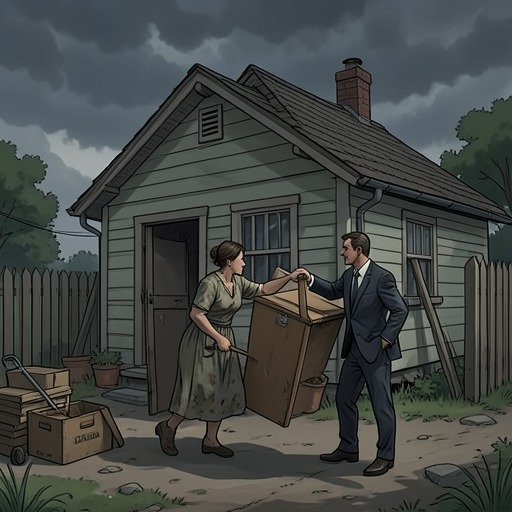
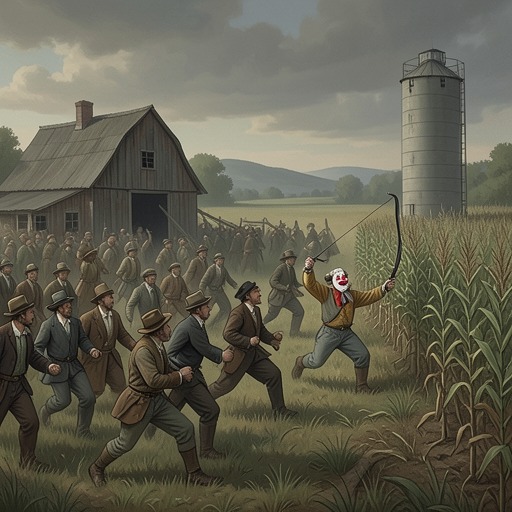
[Victoria Hill](entity:character-recall-character-victoria-hill-ec1218f6577c)’s fatal dive is the abrupt reversal at the center of the reservoir-party scene: a stunt watched as entertainment becomes a death that its witnesses are slow to recognize. [Janet Murray](entity:character-recall-character-janet-murray-1da50990babd)’s camera records the leap, and she alone appears to notice the instant it turns into a fall; afterward, the phone preserves the crowd’s voices but not the rescue or the wound that explains what happened.
## A stunt assembled for an audience
Victoria, the younger sister of [Cole Hill](entity:character-recall-character-cole-hill-7b3f7ee3f031), had not brought a bathing suit to the [Kettle Springs Reservoir](entity:location-recall-location-kettle-springs-reser-8f1d3279f920). She never went in the water. Instead, wearing only her underwear and carrying a half-empty bottle of strawberry vodka, she made her way along the narrow concrete lip on the reservoir’s pitched east side. The route itself signaled the danger: people normally took the long way around on dirt rather than walk that edge. Victoria wobbled as she crossed, but reached the other side without slipping or scraping her knees and elbows before splashing into the water.
She then tossed the bottle aside and climbed the ladder to the first concrete stack. The stack was not a diving board, and the reservoir was not a public swimming pool. Janet, who had been filming with Cole’s phone, nevertheless saw Victoria’s effort as more than an impulsive swim. A distant, grainy image made the moment look candid, but the framing also made it legible as a performance. Janet imagined that Victoria could use the stunt to make the years ahead easier and become popular in one night—an abrupt ascent compared with Janet’s own gradual climb up the social ladder.
The party’s response helped turn that possibility into pressure. [Matt Trent](entity:character-recall-character-matt-trent-1c7c67cb0479) joined the encouragement despite being paid to guard security, and the other partygoers took up the chant. Victoria made two small gymnast-like pumps on the balls of her feet, then jumped. In the crowd’s eyes, the leap belonged to a familiar category of youthful daring: many children had made it before, and the remembered mishaps were limited to bent toenails and bloody noses. That history offered reassurance precisely when the particular danger of this jump was about to become visible.
## The leap becomes a fall
Janet noticed the decisive change. As Victoria passed the edge of the concrete stack, the back of her head bumped it. The movement seemed slight: a tiny jitter, a shift of Victoria’s face by about half an inch as her hair moved past the stack. Yet Janet understood, at least visually, that the descent had changed from a dive into a fall. The distinction is the scene’s hinge. What the others had urged as a stunt continued through the air, but its meaning had already changed before Victoria struck the water.
The sound of her back hitting the surface was overtaken by the crowd’s drawn-out reaction. Everyone watching seemed to sense that something was wrong, but no one moved at once. The familiar success of earlier dives had made danger hard to imagine, and the spectators waited for Victoria to surface. She did so quickly, face down and arms out. The expected ending—a swimmer returning to the party—had become an image of injury, though the crowd’s initial stillness shows how slowly shared excitement gave way to alarm.
## What the camera records—and misses
Janet dropped Cole’s phone. Its camera pointed at the sky, and the livestream continued until the battery died two hours later. The feed therefore kept the event audible while losing its central actions: viewers could hear screaming, but could not see Cole dive in or pull his sister to shore. They could not see that Victoria looked, at first, as if she were sleeping, or the blood gently coming from the back of her scalp when she was lifted. The coroner’s finding supplied the physical explanation the image could not: the back of Victoria’s skull had been caved inward on the edge of the stack.
The failure of the recording is not simply that the phone was dropped. The live image had helped make Victoria’s attempt into a spectacle, and its graininess had lent the scene the appearance of an improvised moment. At the instant that appearance gives way to catastrophe, the camera no longer shows what the people present must confront. The remote audience receives sound without sight; the physical rescue and the injury remain outside its view. Some livestream viewers nevertheless recognized the outcome in the comments before those at the reservoir had fully acted, bluntly identifying the girl as dead.
## The scene’s reversal
The fatal dive turns attention into exposure. Victoria’s stunt is encouraged as a possible route to popularity, while the crowd’s participation makes the leap feel collectively sanctioned; neither the cheering nor the precedent of previous dives can protect her from the concrete stack. Janet’s position as camera operator sharpens the contrast. She is trying to frame a compelling image, yet she also sees the small impact that the distant feed cannot later explain. Her observation does not prevent the fall, but it distinguishes what happened from what the others initially expected to see.
The event’s horror rests in that mismatch between appearance and knowledge. From a distance, Victoria’s jump can look like one more risky party performance; from Janet’s view, a barely perceptible bump marks the instant it becomes fatal. The phone then preserves a different mismatch, carrying screams without the rescue or the visible evidence of injury. The scene moves from anticipated acclaim to death not through a prolonged warning but through a tiny change in the movement of a falling body—a detail one witness sees, even as the surrounding crowd and the livestream cannot yet comprehend its consequence.
Event 2
Baypen factory fire
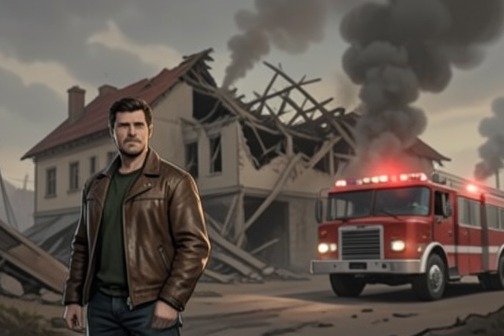
The [Baypen factory fire](entity:event-recall-event-baypen-840b5cfaa371) is both [Cole Hill](entity:character-recall-character-cole-hill-7b3f7ee3f031)’s acknowledged act of arson and an unresolved point of conflict in [Kettle Springs](entity:location-recall-location-kettle-springs-ab38acb2568d). Cole describes it as a drunken mistake at an abandoned family property; others question whether it was accidental, while the fire becomes a public emblem of the town’s economic decline and, later, part of [Sheriff George Dunne](entity:character-recall-character-sheriff-george-dunn-e9f11dfd4f8e)’s vision of [Baypen](entity:organization-recall-organization-baypen-63cac054ad9f)’s return. Its significance lies not only in what burned, but in the competing meanings imposed on the ruin.
## Background and the Fire
By Cole’s account, the fire happened after he had drunk more than he should have. He admits that he burned the factory, then qualifies the admission: it belonged to his family, or at least to his father, and had been empty for more than a year. He describes the boarded-up building as slowly rotting and as a stupid reminder of how things used to be. He does not claim to mourn its disappearance; his regret is that he made a mistake, not that the factory was lost.
That explanation does not make the fire harmless or erase Cole’s responsibility. When [Janet Murray](entity:character-recall-character-janet-murray-1da50990babd) bluntly identifies him as the person who burned it, Cole corrects her emphasis by stressing the factory’s ownership and vacancy. [Tucker Lee](entity:character-recall-character-tucker-lee-772373fbbac6), meanwhile, defends him by saying that nobody was hurt and that the incident simply got out of control. His comparison to a party that had gone too far frames the blaze as youthful recklessness, while Cole’s own account acknowledges a serious act without expressing much sorrow for its target.
The fire did not destroy the factory completely. Janet points out that the interior may have burned out, but the structure still stands; Cole grudgingly accepts her correction that it is only mostly gone. The distinction matters in the novel’s later treatment of Baypen: the building is at once a burned shell and a surviving site that can still be imagined as useful. [Ronnie Queen](entity:character-recall-character-ronnie-queen-4bf4ae3c9c72) also credits Kettle Springs’ volunteer firefighters, describing them as competent. The discussion offers no detailed account of how the fire started, how long it burned, or the firefighting response, and therefore leaves the physical course of the blaze largely outside the scene.
## Competing Accounts and Public Consequences
The fire’s meaning shifts as information emerges. In the first discussion, Cole says he was drunk and that the event got out of control; Tucker backs him, and Cole calls it a mistake. Later, Ronnie says that the Baypen fire was not an accident and reports that Tucker told them Cole wanted to die inside. Cole rejects that claim, insists he is not suicidal, and says they were all drunk. The book thus places a grave allegation beside Cole’s denial without resolving it in these exchanges. His earlier admission establishes that he set the fire; it does not by itself settle whether he intended the consequences or sought his own death.
The investigation also remains an open public matter even after the immediate blame appears to recede. At a town gathering, Cybil Barton notes that the charges against Cole have been dropped and asks Sheriff George Dunne how the Baypen investigation is proceeding. Dunne declines to comment on an ongoing investigation and says that authorities are trying to bring those responsible to justice. The crowd responds with disappointment. The contrast between dropped charges and an investigation still described as active leaves the official status unsettled, rather than providing a clear public exoneration or a final account of responsibility.
In the same address, Sheriff George Dunne uses the fire to frame Kettle Springs’ loss as a civic and personal injury. He recalls that [Arthur Hill](entity:character-recall-character-arthur-hill-d9433dafab37) lost a child the previous year and that his factory burned the week before. Dunne says the town had been waiting for the refinery to reopen, and links Arthur Hill’s lack of emotional and financial investment in Kettle Springs to what has been taken from him. He also blames the town’s declining population and young people’s indifference to local history and heritage. For the assembled community groups, the ruined Baypen is therefore more than damaged property: it stands for lost employment, a diminished town, and the estrangement of a prominent local family. Dunne’s speech turns Cole’s act into part of a broader grievance, even as it risks conflating the factory’s destruction with the town’s deeper decline.
## Baypen’s Reinterpretation
Cole’s description of the factory as a decaying reminder of the past collides with Dunne’s public hope that it will reopen. The same building can signify stagnation to Cole and a possible economic revival to those waiting for Arthur Hill to invest again. That opposition is sharpened by Dunne’s account of Baypen as the place where the town’s future might be recovered: he tells Cole to think of himself as a phoenix, whose death would become a rebirth, and names the reopening of Baypen and the saving of Kettle Springs as the promised outcome. The language makes the factory’s return part of a violent political design, not simply a matter of repairing a fire-damaged structure.
The scene also connects that design to Sheriff George Dunne’s generational ideology. He explains that he had been thinking about his doctrine before [Victoria Hill’s death](entity:event-recall-event-f84d83982092), but that what happened to her and the young people involved intensified it. He describes Cole and his friends as a blighted crop that must be cut down or burned so the land can recover. Cole answers that Dunne is proposing to wipe out a generation because of perceived disrespect, and mocks the promise to make Kettle Springs great again. Within this argument, the old factory’s fire and the proposed destruction of young people are made to mirror one another: both are folded into a story of clearing away what is judged damaged so that an older order can be restored. The novel does not make Cole’s fire and Dunne’s plan identical acts, but the contrast exposes the danger of turning loss into a justification for further violence.
## Aftermath and Significance
Cole’s brief admission contains a tension that the later revelations do not resolve: he accepts that he caused the blaze, yet regards the factory’s disappearance as no great loss; others treat it as a crime, a possible suicide attempt, or a wound to the town’s prospects. Its incomplete destruction leaves that disagreement materially visible. Baypen remains standing, but burned inside, suspended between ruin and the prospect of reopening.
As a plot event, the fire links Cole’s grief and self-destructive reputation to Kettle Springs’ economic anxieties and Sheriff George Dunne’s restorationist project. It gives the town a concrete loss around which to organize its resentment, while its uncertain circumstances keep the reader alert to the difference between an individual’s explanation and the stories other people build around it. The fire is at once an act Cole owns, an investigation the sheriff will not discuss, and a symbol claimed by those who want Baypen—and the town they associate with it—to return.
Event 3
Tillerson cornfield party
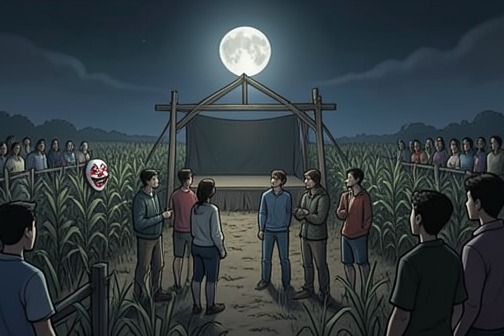
The [Tillerson cornfield party](entity:event-recall-event-eeca7e64b948) is the night’s passage from small-town celebration into catastrophe. [Janet Murray](entity:character-recall-character-janet-murray-1da50990babd) has spent much of the week organizing it, and [Quinn Maybrook](entity:character-recall-character-quinn-maybrook-fdd4f8b5a108) arrives as a newcomer drawn into the group; among the corn, music, and crowded barn, the party briefly offers a place to belong. But the clearing’s isolation cannot protect the teenagers. A warning that people will die turns celebration into flight, and Erin Werther is killed as partygoers force their way into a silo.
## Invitation and the festival backdrop
Quinn Maybrook’s route to the party begins with an attempt to enter a conversation. After asking where the group filmed its creepy clown video, she hears that it was made at [Tillerson barn](entity:location-recall-location-7549c396c96c). [Cole Hill](entity:character-recall-character-cole-hill-7b3f7ee3f031) stops mid-thought and points toward Janet Murray, who says the gathering is open to everyone. Cole clarifies that Janet has spent much of the week putting a party together, then tells Quinn she is definitely coming. The invitation leaves Quinn buying time with a question of her own: she is not yet sure what she has agreed to, or how much she wants to join the group.
The invitation follows another, public gathering: [Founder’s Day](entity:time-recall-time-founder-s-day-b7a557c3a5b5). Quinn had been reluctant to attend the festival and had struggled to think of a reason to give her father for skipping it. After an hour there, however, nobody had told her she was banned or asked her to leave. The festival is larger than she expected, with food, music, visitors from neighboring towns, and a small carnival of trailer-borne rides and midway games in the school parking lot. This welcome contrasts with Quinn’s hesitation about entering a new social circle, while also showing how readily [Kettle Springs](entity:location-recall-location-kettle-springs-ab38acb2568d)’ teenagers make room for their own, less official celebration.
An earlier parade has already blurred the boundary between sanctioned festivities and youthful disruption. Whistles and pops along the route are mistaken by the crowd for part of the show, and people clap and cheer. Quinn knows the sparks are not on the official program, but she smiles too: the prank may be Janet’s act of defiance, yet it is giving people joy. That mixture of rule-breaking and pleasure carries into the party, where the teenagers make their own event beyond the town’s formal spaces.
## Through the corn to the clearing
Before reaching the party, Quinn, Cole, and Janet encounter [Frendo](entity:character-recall-character-frendo-92595b07eac5) standing in the road. Janet’s startled, involuntary kick into Quinn’s back accompanies her warning; Cole brakes and swerves, but the car sideswipes the clown, sweeping its polka-dot body over the roof. Cole gets out and kicks the head in anger. The skull bursts into hay: Frendo is a scarecrow. [Matt Trent](entity:character-recall-character-matt-trent-1c7c67cb0479) emerges laughing from the corn and identifies the encounter as a prank, calling it his best one yet. The scare is thus exposed as a staged trick before the group follows Matt toward the party.
Cole drives off the highway and straight into standing corn, pushing down stalks until the car reaches a small clearing several dozen yards in. The cars are kept out of sight from the road in case a highway patrol officer passes and decides to break up a high-school party. Matt’s cherry-red two-seater is so small that he climbs out through its driver’s-side window. From behind the front seat he retrieves two Frendo costumes in clear plastic laundry bags and tosses one to [Ronnie Queen](entity:character-recall-character-ronnie-queen-4bf4ae3c9c72). The masks and costumes extend the evening’s clown imagery, which has moved from a roadside scare into party equipment.
Quinn, Cole, and Janet continue on foot, passing lost teenagers using phone flashlights to find their way. Music first reaches Quinn as a muffled, atonal buzz, then resolves into a familiar Kid Cudi song. Orange firelight and strobes rise above the corn, while more arrivals rustle and break the stalks around them. Some carry six-packs; others bring tiki torches. When the three finally emerge from the rows, they find a clearing about the size of a high-school running track, perhaps larger. Tillerson barn stands open at both ends, so the dark rows remain visible through it. Beside it, the old silo’s sparse red paint is cracking and its structure leans; the barn roof sags as well. Janet calls the place perfect and runs ahead, while Quinn and Cole pause at the edge.
## A temporary, crowded freedom
The party’s setting is both expansive and enclosed. The corn conceals the gathering from the highway, but the trampled clearing, open barn doors, and single disused silo become the limited geography through which hundreds of young people must move. The buildings look neglected rather than secure: the silo leans, and the barn’s roof dips in the middle. At first these are signs of the place’s shabby appeal, not yet a warning of what the crowd will face.
Inside, the dance floor grows oppressive after three songs. The barn doors are open wide, but the combined body heat of the teenagers still weighs on the space. Its music refuses a single local or urban identity: underground tracks associated with after-hours [Philadelphia](entity:location-recall-location-0c859ef79004) sit alongside amplified honky-tonk. At one point, students from [Kettle Springs High School](entity:location-recall-location-kettle-springs-high-27950c89da60) form three lines to line dance. Quinn finds the steps strange and unexpectedly fun, and harder than they look. The party’s vitality lies in these collisions—different sounds, improvised dancing, and a crowd making a temporary world for itself in a failing farm complex.
That temporary ease is not the same as lasting safety or equality. Quinn’s entry into the group has depended on an invitation, and the party’s apparent openness rests on the teenagers’ ability to gather beyond town oversight. Its remoteness helps them evade a patrol officer, but once danger arrives, the same crowded, improvised arrangement offers no dependable protection. The contrast gives the party its sharp turn: a gathering that had made room for music and new companionship becomes a place where survival depends on finding an exit.
## Warning, flight, and fatal consequence
The change is announced in a warning that obedience might keep someone from being among those who die that night. The threat cuts across the party’s ordinary noise and recasts the gathering: the crowd is no longer simply dancing in an isolated clearing but facing an immediate danger. As panic takes hold, teenagers move in conflicting directions. Most head for the corn or try to get into the barn, while a group works to close the barn’s large wheeled doors. Cole is pulled along toward the silo instead.
At the silo, Erin Werther holds the small door open as the group rushes toward the entrance. A bolt catches between the door and its jamb and strikes her at the side of the head, shattering her glasses. She dies before reaching the floor. The moment is brutally distinct from the party’s earlier play with frightening images: the clown scare had ended in hay and laughter, but here a doorway and a bolt make the danger real and irreversible. The party’s atmosphere of self-made festivity gives way to the physical pressure of people trying to escape together, and the silo becomes the site of a death during that flight.
## Significance
The party gathers the book’s contrasts into one place: a welcoming invitation alongside Quinn’s uncertainty, a playful scarecrow prank beside genuine mortal danger, and a crowded dance floor inside buildings visibly past repair. Its isolation first enables the teenagers to assemble without attracting attention; when the warning comes, it magnifies their vulnerability. The movement from the corn’s darkness into firelight and music promises a communal refuge, but the rush toward the silo exposes how quickly that fragile community can be overwhelmed. The Tillerson cornfield party is therefore not only a social gathering but the setting where youthful freedom is abruptly converted into a fight to get out alive.
Event 4
Kettle Springs Founder’s Day parade accident
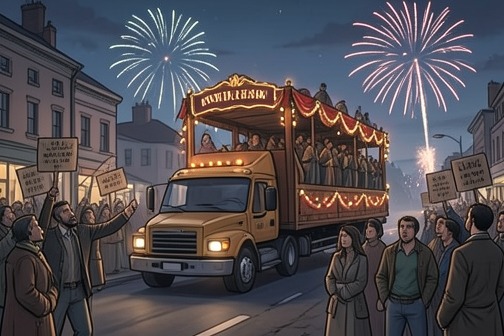
The [Kettle Springs Founder’s Day parade accident](entity:event-recall-event-kettle-springs-founder-644b39b646bc) transforms a crowded community celebration into a sequence of fires, collisions, and near misses. Unauthorized fireworks first look like a mischievous enhancement to the parade; sparks then ignite a float, and an M-80 explosion sends another vehicle out of control. The danger grows in full public view, while [Sheriff George Dunne](entity:character-recall-character-sheriff-george-dunn-e9f11dfd4f8e)’s pursuit of [Cole Hill](entity:character-recall-character-cole-hill-7b3f7ee3f031) briefly competes with the effort to keep people safe.
## A festival turns into a spectacle
[Quinn Maybrook](entity:character-recall-character-quinn-maybrook-fdd4f8b5a108) had been reluctant to attend [Founder’s Day](entity:time-recall-time-founder-s-day-b7a557c3a5b5) and had struggled to explain to her father why she wanted to skip it. Yet after an hour at the festival, no one had asked her to leave or told her she was banned. The scale of the day surprised her: food, music, visitors from neighboring towns, and a small carnival installed in the [Kettle Springs High School](entity:location-recall-location-kettle-springs-high-27950c89da60) parking lot. That festive abundance makes the turn toward danger more jarring. This is not a gathering already defined by panic; the crowd has assembled to enjoy a familiar civic ritual.
A shrill whistle-hiss from farther along the route interrupts the parade, followed by a loud pop. The crowd flinches together, but the sound is quickly taken for fireworks. [Janet Murray](entity:character-recall-character-janet-murray-1da50990babd) tells Cole that it is only a few light pyrotechnics. More hissing draws attention to the parade’s giant ear of corn, where sparks erupt from the platform’s four corners. People clap and cheer, believing the fireworks are part of the show. Quinn knows they are not official, but finds herself smiling too: the prank, which she associates with Janet’s defiance, is giving the crowd a moment of pleasure even as it threatens to get her friends in trouble.
That temporary shared excitement is the accident’s first reversal. The fireworks do not remain a harmless interruption or a performance the crowd can simply enjoy. The driver of the throne-float brakes when the corn catches fire all at once; the sparklers are too close to its plaster construction. The giant cob becomes a rolling fireball on [Main Street](entity:location-recall-location-main-street-e23229e4e5ad). What looked like a spontaneous addition to the parade has altered the procession itself, turning its moving floats and gathered audience into parts of an unfolding emergency.
## The floats collide
Janet’s mother is thrown from her seat. The person wearing the King [Frendo](entity:character-recall-character-frendo-92595b07eac5) costume reaches for her but is too late, tearing away her sash instead. The mishap is not isolated: as firefighters scramble clear, the third float rear-ends the truck. Janet’s mother and the costumed figure are thrown back in the opposite direction. The third platform carries local Cub Scouts on a large fish, bringing children directly into the chain of collisions.
Firefighters rapidly attack the burning corn with extinguishers, but their attention is on the flames rather than the slow-motion wreck behind them. Scouts cry on top of the fish; a couple stumble and fall from the platform. More fireworks hiss and pop farther down the street, now sounding not like entertainment but like an aftershock to the chaos. On the sidewalk, Quinn and the other onlookers hold their breath, watching children caught in the accident. The scene’s danger lies not only in the fire but in the way each moving float and vehicle creates a fresh hazard before the crowd can understand the last one.
[Glenn Maybrook](entity:character-recall-character-glenn-maybrook-ac75628b4082) runs into the road to help, stooping to assist one of the children as other parents gather the Scouts. His instinct to move toward the injured contrasts with the helplessness of the spectators, who can only watch the collision unfold. The account stresses that the accident could have been much worse: no death is reported in this episode, but the children’s exposure to fire, falling, and moving vehicles makes the possibility feel immediate.
## Suspicion and a second explosion
As the first emergency is still unfolding, Sheriff George Dunne seizes Cole by the shirt and demands to know whether he caused the fireworks. He sweeps away Cole’s cardboard mask and lifts him off his feet, shaking him hard enough to tear the fabric. Cole says he did nothing. Janet tries to intervene, insisting that Cole was not responsible and that they did not mean for this to happen. Dunne calls her claim a lie and flings her onto the sidewalk. Her mask twists over her eyes; dazed and kneeling, she paws at it while the sheriff continues to hold Cole.
Dunne tells Cole that he is finished in [Kettle Springs](entity:location-recall-location-kettle-springs-ab38acb2568d), but another bang cuts through the confrontation. This explosion is distinct from the earlier fireworks. It comes from farther down the block, toward the [Eureka Theater](entity:location-recall-location-eureka-theater-cca885ca9e55), and the crowd’s brief gasp turns into screams. Janet recognizes the danger of M-80s and tries to rise, still blinded by her twisted mask. Dunne drops Cole and runs toward the new emergency. His earlier aggression does not vanish, but the sudden change in direction shows the competing demands of the moment: he has been treating Cole as a suspect, yet now runs toward the danger to respond.
The explosion has shredded the front tire of the truck towing the Elks Lodge float, an elaborate ten-foot papier-mâché buck. The damaged vehicle swerves, missing riders displaced from the earlier floats, and heads toward Glenn as he tends to an injured Scout. Glenn pulls the child clear at the last moment. The truck then sails past and its fender collides with a lamppost on the south side of the block. The impact stops the vehicle, but the buck’s forward motion sends the sculpture toppling from its platform. The parade’s enormous props, intended to represent local pride, have become dangerous physical objects whose weight and motion carry the accident forward.
## Aftermath and significance
The falling buck’s antler slices downward, and the smoldering corn is carved in two, splitting the words Kettle Springs across the damaged float. The image gathers the episode’s reversals into one visible result: the town’s name, carried as part of a celebration, is literally divided by the collision. The spectacle that first united the crowd in applause ends in broken displays, injured participants, frightened children, and a community forced to confront the consequences of an unauthorized prank.
The accident also complicates blame. Quinn connects the fireworks to an act of defiance and suspects [Tucker Lee](entity:character-recall-character-tucker-lee-772373fbbac6) lit them along the route, while Dunne fixes on Cole and uses force before establishing responsibility. The immediate record does not resolve every participant’s role; it shows instead how quickly suspicion becomes part of the crisis. Janet’s effort to defend Cole, the firefighters’ divided attention, Glenn’s rescue, and Dunne’s eventual charge toward the second emergency all unfold amid the same breakdown in control.
As a turning point in the festival, the parade accident makes celebration inseparable from danger. The first fireworks briefly create a sense of collective fun; their ignition of the corn float converts that pleasure into fear, and the M-80 blast compounds the hazard before the first wreck has settled. The procession cannot restore its earlier innocence: its props, performers, children, and spectators have all been drawn into the consequences of the prank.
Event 5
Kettle Springs emergency meeting and mass deputization
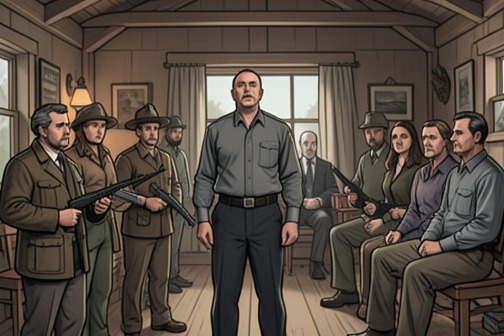
The [Kettle Springs emergency meeting and mass deputization](entity:event-recall-event-kettle-springs-5e59863b9eda) marks the moment when public anger over the [Founder’s Day](entity:time-recall-time-founder-s-day-b7a557c3a5b5) parade becomes organized civic action under [Sheriff George Dunne](entity:character-recall-character-sheriff-george-dunn-e9f11dfd4f8e). In a lodge meeting held after the parade fireworks stunt, Dunne identifies a suspected minor, calls for eligible residents to become deputies, and sidelines Mayor [Harlan Jaffers](entity:character-recall-character-harlan-jaffers-9f2f150ccaf2). What appears to be a response to disorder is also a step in the [Kettle Springs](entity:location-recall-location-kettle-springs-ab38acb2568d) Improvement Society’s gradual effort to recruit support for its larger plan.
## Background: A town primed for action
At an earlier meeting about whether to cancel Founder’s Day, Harlan Jaffers tried to defend the festival against residents’ complaints and the town’s economic troubles. He stressed that volunteers had prepared the floats and costumes on only a quarter of the usual budget, and praised the hand-painted banners. Residents countered that the fire engine’s pump had been damaged fighting [Cole Hill](entity:character-recall-character-cole-hill-7b3f7ee3f031)’s fire, raising concerns about the parade and the town’s ability to respond to another blaze. Another speaker argued that advertising on I-44 could bring visitors and business downtown.
Jaffers then offered a more consequential possibility: [Arthur Hill](entity:character-recall-character-arthur-hill-d9433dafab37) might attend the parade and, if impressed, consider investing in Kettle Springs again. Arthur had been absent from town for nearly a year, and residents associated his withdrawal with the death of his daughter, [Victoria Hill](entity:character-recall-character-victoria-hill-ec1218f6577c). The prospect briefly quieted the complaints, but Sheriff George Dunne redirected the meeting toward the community’s grievances. He argued that law and what was right might diverge, invoked [Mr. Vern](entity:character-recall-character-mr-vern-7af919084c98)’s effort to discourage certain students from attending Founder’s Day, and presented the town’s loss of Arthur’s emotional and financial support as a consequence of what had been taken from him and from Kettle Springs. Dunne called on residents to stop waiting for rescue and take action to restore the town.
## From festival to emergency meeting
[Quinn Maybrook](entity:character-recall-character-quinn-maybrook-fdd4f8b5a108) had been reluctant to attend Founder’s Day, uncertain whether she would be welcome, but she found a substantial festival underway. Food, music, visitors from nearby towns, and a small carnival in the school parking lot made the event larger than she had expected. When fireworks began along the parade route, many in the crowd assumed the sparks and sharp reports were part of the show. Quinn recognized that they were not official, yet she too smiled: the apparent defiance associated with [Janet Murray](entity:character-recall-character-janet-murray-1da50990babd)’s stunt was giving the spectators pleasure.
After the parade, the emergency meeting drew fewer people than the previous night’s planned gathering, but its audience was more hostile. Jaffers struggled to command the room and reminded the crowd that he was still mayor. Dunne first quieted the audience on the mayor’s behalf, then announced that he had reason to believe a minor had set off the parade explosives. He withheld the suspected person’s name until charges were filed, while inviting the crowd to draw its own conclusions. Bill Stevens, an assistant principal at [Kettle Springs High School](entity:location-recall-location-kettle-springs-high-27950c89da60), and another attendee challenged the claim that the students had been kept away from the event. The accusation left suspicion in the air without resolving who was responsible.
## The call to deputize
Dunne shifted from accusation to a proposal for collective action. He asked everyone who was willing, able-bodied, and old enough to be deputized to join, framing the response as a need for the town to unite and act. Anyone unwilling to be deputized, he said, would have to leave. The announcement drew murmurs of enthusiasm and amazement. Jaffers objected that the arrangement made the town resemble the Wild West, but the crowd was already responding to Dunne’s call rather than to the mayor’s protest.
Jaffers tried to adapt. Hoping that joining the deputies might rebuild trust with his constituents, he volunteered to be deputized. Dunne refused, explaining that a mayor could not become a deputy and directing him to the bylaws if he doubted the rule. The procedural distinction had an immediate political effect: Jaffers could neither join the new group nor retain the room’s attention. Someone in the back asked him to leave, another said the town had work to do, and the gathering silently assented. With Dunne holding the crowd’s support, Jaffers collected his briefcase and trudged toward the back door.
## A public response and a concealed design
As Jaffers departed, Dunne began to hint at information available only to the deputies. He referred to an inside source and paused as if making clear that the coming disclosure was privileged. The meeting thus ended not with an open investigation or a public account of the alleged offense, but with a new boundary between those admitted to the deputized group and the mayor who had just been pushed out. The crowd’s willingness to accept that boundary made the call to deputize a transfer of practical authority as well as a show of unity.
Dunne later explained that the parade stunt had helped his allies persuade residents that they needed to act quickly. For months, the Kettle Springs Improvement Society had been bringing potential supporters together, withholding parts of its purpose from some members to avoid frightening them off. He also disclosed that [Dr. Weller](entity:character-recall-character-dr-weller-d638007293bb), once a vocal supporter, had threatened to expose the group, and that the Society had dealt with that threat collectively. Read alongside this later account, the emergency meeting is not simply a spontaneous response to fireworks: it is a recruitment opportunity created by a carefully cultivated sense of crisis. Its promise of community protection is shadowed by the Society’s selective disclosures and by the violence it conceals.
Event 6
Harlan Jaffers stabbing and abduction
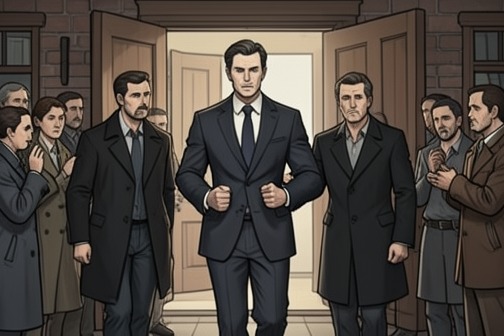
[Harlan Jaffers stabbing and abduction](entity:event-recall-event-c3c0ac680e83) begins in the aftermath of Harlan’s defeat at a public meeting and ends with him being taken away alive. The attack links the town’s political humiliation of its former mayor to a sudden, carefully staged act of violence: the meeting’s audience has already accepted [Sheriff George Dunne](entity:character-recall-character-sheriff-george-dunn-e9f11dfd4f8e)’s authority, and outside, a [Frendo](entity:character-recall-character-frendo-92595b07eac5)-costumed attacker makes Harlan’s isolation literal.
## Political Defeat and the Exit
Before the assault, Harlan is still in the lodge as Sheriff George Dunne addresses the room. Dunne pauses while promising inside information from a trusted source, then looks toward Harlan with an expression that makes clear the information is for deputies only. Harlan understands the signal and says he is leaving. The exchange places his exclusion in public view: the sheriff controls not only the meeting but also who is allowed access to what the town is about to hear.
The room has already turned against Harlan. Someone in the back asks him to leave, another person says the townspeople have work to do, and the rest of the audience silently assents. Harlan wishes he could knock the grin off Dunne’s face, but recognizes the imbalance between them: Dunne is larger, armed, and supported by the town. Harlan gathers his briefcase and trudges toward the back door, his footsteps loud in his own ears. His physical retreat follows a political one.
Outside, Harlan remembers that three terms as mayor have ended over what he calls a few fireworks: sparklers, a four-vehicle fender-bender, a damaged lamppost, and construction paper. He believes that [Kettle Springs](entity:location-recall-location-kettle-springs-ab38acb2568d)’s hard times were not his fault and that the town will never know how much worse things might have been without him. The thought gives his departure a particular bitterness. He considers himself a capable mayor who has been discarded, even as the meeting has shown how completely the room now belongs to Dunne.
## The Attack in the Parking Lot
Harlan steps into the cool night air and remarks aloud that he should have brought a hat. The parking lot appears empty; he sees no one standing in the dark or in the shadows. When he fumbles for his car keys, he drops the fob into an oil-glazed puddle. As he bends to retrieve it, he barely hears footsteps behind him and supposes that someone else may be leaving the meeting, perhaps tired of Dunne’s bullying. That mistaken possibility briefly makes the approaching presence seem ordinary.
The wet asphalt reveals what Harlan has not heard clearly: a rippling shadow in its reflection. He recognizes the silver-and-red colors of Frendo’s costume, along with white greasepaint and a beard smudged with cigar ash. His response is curiosity rather than fear; he turns to see why someone dressed as Frendo has followed him. The interval between recognition and violence is almost nonexistent. The costume is visible, but it gives him no practical time to understand the threat or escape it.
The attacker aims an ice pick at Harlan’s temple, but misses and drives it into the side of his neck, where it stops only after nicking a vertebra. The wound leaves Harlan instantly weak. The attacker pushes the weapon farther, parting nerves and cartilage until its handle is buried in his neck. Harlan cannot work up a scream, so the assault requires no hand over his mouth to silence him. The scene’s brutality is conveyed through its precise physical consequences, not through a struggle or a spoken confrontation.
## Wounding and Abduction
Harlan drops to his knees beside the puddle where his keys have fallen. He then lies on the pavement, staring at the nearest streetlight and gurgling for two minutes as he loses blood. The measured duration makes the attack more than a sudden blow: the narrative holds on the interval in which he remains conscious but unable to call for help, before he loses enough blood to become unconscious. The streetlight supplies the fixed point of his gaze while the meeting and its crowd are left behind.
Frendo transfers Harlan to the back of a waiting van. The attacker’s preparation is apparent in the vehicle’s presence, but the account does not disclose who is driving, where the van will go, or what is intended for Harlan afterward. The event therefore ends not with a confirmed death but with the mayor removed from public view and his fate unresolved. His final thought, “Still mayor,” preserves his former office as the last measure by which he understands himself. The line is bitterly at odds with what has happened: publicly displaced from power, stabbed, and carried away, he nevertheless clings to the title as the assault closes around him.
Event 7
Tucker Lee’s killing
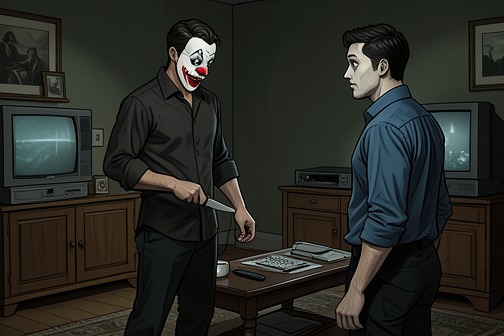
[Tucker Lee’s killing](entity:event-recall-event-cfa610723f06) turns a prankster’s confidence against him: after dismissing the figure as a joke, Tucker discovers that [Frendo](entity:character-recall-character-frendo-92595b07eac5) is armed and stronger than he is, and his attempt to call for help ends in a fatal attack. The scene’s shift from mediated image to physical violence makes the clown’s arrival first seem like a scare and then impossible to dismiss.
## The Apparition at the House
A camera feed first shows Frendo standing motionless on Tucker’s front porch, feet planted on the welcome rug. In the low-light, desaturated image, the clown seems ghostlike; the camera’s fisheye distortion exaggerates the mask’s nose and smile. Tucker is startled, his heart racing. He enjoys frightening unsuspecting people, but does not like being frightened himself. The image therefore reverses the terms of his usual pranks: Tucker is now the one watching an apparent joke that he cannot control.
Tucker goes through the kitchen while texting, then enters the dark living room distracted by his phone and the thought of taking a beer from the basement fridge. Frendo is already inside, standing between the coffee table and media center, with mud tracked onto the carpet. Tucker assumes the visitor came in through the front door while he went around back. He addresses the figure as a prankster and demands that the mask come off, even offering a way to clean the footprints and leave. Frendo answers only by tilting his head, then reveals an unusually long knife that Tucker initially mistakes for a costume prop. The contrast between Tucker’s casual, mocking response and the weapon’s real danger establishes how long his assumptions protect him from recognizing the attack.
## The Attack and Failed Call
Tucker treats the knife as another part of the costume. He swats at it, expecting the blade to fly away like a toy, but Frendo’s grip holds firm. The gesture costs him: the blade splits the webbing between Tucker’s thumb and forefinger, and as he looks down at the wound, Frendo raises the knife and presses its tip beside Tucker’s navel. Tucker’s phone slips from his bloody fingers and skids beneath the couch, turning the device he had been absorbed in moments earlier into something he cannot reach.
Tucker fights back when he realizes he and Frendo may both go for the cell phone. Grabbing the clown’s coveralls, he swings down hard, using Frendo’s own backward momentum to drive them through the glass coffee table. The pom-pom buttons shake as they crash among the shards. The fall leaves Tucker closer to his cell phone than to the corded handset on the end table, so he struggles toward the dropped mobile instead of the landline. Even bleeding heavily, he wipes his thumb on the carpet, presses to keep pressure on his stomach, and manages to unlock the phone and reach the call screen.
He enters the first two digits, but Frendo is already back on his feet. White-gloved fingers pull Tucker’s head backward, stretching the skin taut; the same gloves that evoke a clown’s balloon tricks now hold him in place. As Tucker’s thumb waits over the green dial button, the blade runs across his neck. The attempted call never connects: [Tucker Lee](entity:character-recall-character-tucker-lee-772373fbbac6) dies before he can summon help.
## The Interrupted Call
The scene tightens around a sequence Tucker cannot finish: the digits 9 and 1 appear separately as he navigates the call screen, and his thumb reaches the green dial button only as Frendo pulls his head back. After the blade crosses Tucker’s neck, the narration gives one final, isolated word: Nine. The broken progression makes the attempt to summon help register in fragments rather than as a completed call. The next beat shifts abruptly to Cole asking Quinn whether she is okay, leaving Tucker’s death as a hard interruption between scenes rather than a rescue or an extended aftermath.
## The Prank Reversed
The cracked phone connects Tucker’s confidence before the attack to his final attempt to escape it. After seeing Frendo on the porch camera, he texts, “Nice try assholes,” treating the image as a prank even as it has already unsettled him. In the living room, the same device keeps his attention on the message and away from the figure who has entered the house. Once violence begins, it becomes both unreachable beneath the couch and, after Tucker fights through the broken coffee table, his only chosen means of summoning help.
That reversal gives the scene’s clown imagery a harder edge. Tucker’s balloon-animal gloves are no longer comic props when they hold his head still, just as the oversized knife cannot be dismissed as a costume accessory. The performance Tucker expects to expose as a joke instead conceals an assailant; his practiced ease at mocking a scare offers no protection once the mask’s threat becomes physical.
Event 8
Samantha Maybrook’s death
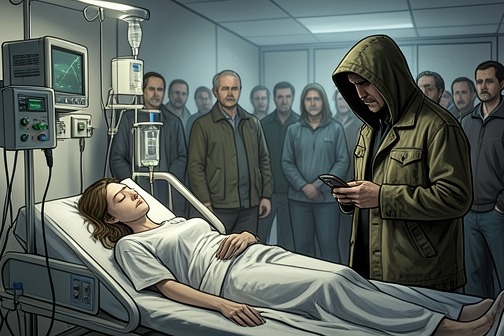
[Samantha Maybrook’s death](entity:event-recall-event-2c13b1429969) from an opioid overdose is the loss that fundamentally changes [Quinn Maybrook](entity:character-recall-character-quinn-maybrook-fdd4f8b5a108). The novel presents it not as an isolated medical fact but as a wound with a long approach and a delayed emotional life: addiction becomes public knowledge, recovery is promised and attempted, and the death reshapes how Quinn understands herself and her family. Recalled while Quinn is trying to remain present among people watching her, Samantha’s death also explains why an apparently ordinary moment can reopen grief rather than leave the past behind.
## Addiction and the fatal overdose
Samantha’s addiction is described in blunt, stigmatizing terms by the people who learn about the family online: she was dependent on opioids and had progressed to heroin. Quinn knows that strangers can search for what happened and reduce her mother to that history. The whispers at school make a private bereavement publicly legible in the harshest possible way, leaving Quinn to face both the loss itself and other people’s knowledge of it. The account does not soften the reality of Samantha’s addiction, but it shows how exposure turns that reality into a source of shame and pressure for her daughter.
The fatal overdose is described through its bodily consequence: Samantha’s brain stopped telling her lungs to breathe. That plain explanation gives the death a stark physical mechanism, while Quinn’s urge to disappear registers its emotional force. The account identifies the overdose as the last one, after Samantha had promised to get clean. The promise matters because it places hope and recurrence together: recovery had been imagined, but the death followed an addiction that had not ended. The evidence does not give a date for the overdose itself, so the loss is defined less by a calendar marker than by its enduring effect on Quinn.
## Quinn’s response and her father’s care
Quinn had begun seeing Dr. Mennin shortly before the last overdose. Before Samantha’s death, she already wanted to withdraw from the world; afterward, that impulse gave way to a feeling of being flattened. Her therapist challenged withdrawal as an invalid way to cope, but Quinn resisted the judgment because Dr. Mennin did not have to attend school and endure the whispers. Even as Quinn called the therapist’s view nonsense, she recognized that it contained some truth. The recollection thus holds resistance and self-recognition together rather than treating therapy as an instant remedy.
In the period after Samantha’s death, Quinn’s father, [Glenn Maybrook](entity:character-recall-character-glenn-maybrook-ac75628b4082), became the person who kept her connected to daily life. He pulled her out of bed, made sure he was home when she returned from school, took her to the movies, made her eat, and lay on the floor beside her bed until she fell asleep. These ordinary acts form a specific record of care: they answer Quinn’s withdrawal with presence, routine, food, and companionship. The account says that things eventually began to improve, but it does not turn that improvement into a clean end to grief. As Dr. Mennin repeatedly reminded Quinn, grief does not follow dates.
## Recovery, memory, and family history
A brief earlier memory complicates the family’s experience of opioids. After Samantha broke her coccyx, her doctor prescribed an opioid for pain along with a stool softener; the opioid could worsen constipation, so Samantha was told to take extra stool softener at first and drink plenty of water. On the first night, Glenn took only a tiny fraction of a pill because he was worried about its effects, then joked about Quinn’s mother being a junkie, and Quinn laughed. The episode is not presented as the origin of Samantha’s addiction. Instead, its later contrast with the overdose makes the word and the joke carry a weight neither character could contain in that earlier moment.
That contrast sharpens through two later images: Glenn and Quinn were no longer laughing when they went to collect Samantha from rehab in February 2017, or as they traveled in the funeral traffic descending from the service at Laurel Hill Cemetery. The sequence gives recovery and burial distinct places in the family’s history without suggesting that treatment erased what came before. Quinn’s memory moves from a small, almost casual joke to the practical act of picking Samantha up from rehab, then to the slow procession away from the funeral. Those returns make the death feel less like a single point than a loss repeatedly encountered through what the family had hoped, done, and endured.
## The death’s lasting significance
The novel explicitly distinguishes Samantha’s death from Quinn’s later experience of taking a human life. As Quinn wonders what she should feel after killing someone who died while doing something horribly evil, she recalls that her mother’s death meant something and fundamentally changed who she was. The comparison does not make the deaths morally equivalent. Instead, it shows Quinn measuring a new, violent experience against the earlier loss that had already formed her sense of grief. She cannot assume that every death will produce the same feeling simply because both involve a life ending.
The recollection also resists a tidy recovery narrative. Quinn had professional help, Glenn’s sustained care, and a period in which life began to improve; later, Glenn himself finally fell apart. His collapse underscores that the person who had held Quinn up was also grieving, and that his support had not made him immune to loss. When Quinn finds herself dancing with Cole Maybrook and thinking about contacting Dr. Mennin, the need for help is not evidence that all progress has vanished. It shows that Samantha’s death remains part of the present: grief can recede, return, and alter the meaning of a new moment without obeying a schedule.
Event 9
Victoria Hill’s death
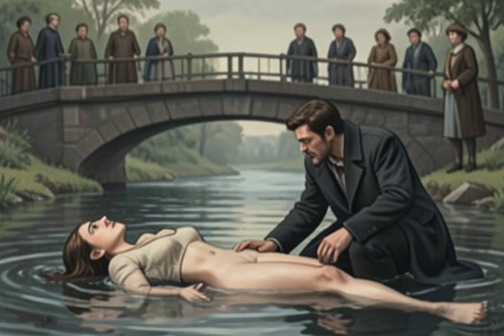
[Victoria Hill’s death](entity:event-recall-event-f84d83982092) at the [Kettle Springs Reservoir](entity:location-recall-location-kettle-springs-reser-8f1d3279f920) is both a family tragedy and a fault line in [Kettle Springs](entity:location-recall-location-kettle-springs-ab38acb2568d)’ later violence. The available account establishes that she died after an incident at the reservoir involving her brother [Cole Hill](entity:character-recall-character-cole-hill-7b3f7ee3f031) and his friends, but does not detail the accident itself. What it does show is how the loss endured: Cole carried regret and a wish to exchange places with her, [Arthur Hill](entity:character-recall-character-arthur-hill-d9433dafab37) came to regard Cole as her killer, and [Sheriff George Dunne](entity:character-recall-character-sheriff-george-dunn-e9f11dfd4f8e) used the tragedy to help justify a campaign against young people.
## Background and the Reservoir Incident
The incident occurred the previous year. Victoria was Arthur’s daughter and Cole’s sister; after her death, blame spread through Kettle Springs. Residents who disagreed about much else nevertheless came to believe that [Harlan Jaffers](entity:character-recall-character-harlan-jaffers-9f2f150ccaf2) had mishandled the situation with Arthur’s daughter. The town’s response thus extended beyond the immediate family, turning the death into a matter of public judgment as well as private grief.
Cole’s recollection supplies one stark detail about Victoria’s final hours: she was still alive in the ambulance and squeezed his hand. That brief contact makes the aftermath especially painful in retrospect. It places Cole beside his injured sister, still connected to her, while his later understanding of the night hardened into regret. The evidence does not specify the exact circumstances of the incident or establish the precise actions that caused her death; those limits matter because the characters’ interpretations of responsibility become central to the conflict.
## Grief and Competing Judgments
Cole’s friends understood the loss as a lasting fracture in him. [Matt Trent](entity:character-recall-character-matt-trent-1c7c67cb0479) tells Cole that he has not cared about his own safety since Victoria died. [Ronnie Queen](entity:character-recall-character-ronnie-queen-4bf4ae3c9c72) raises the [Baypen factory fire](entity:event-recall-event-baypen-840b5cfaa371), saying [Tucker Lee](entity:character-recall-character-tucker-lee-772373fbbac6) had told them Cole wanted to die there. Cole denies being suicidal, but the confrontation makes clear that his friends interpret his reckless behavior through the grief that followed his sister’s death. Their concern also changes the immediate stakes: they urge him not to open a door and endanger the people sheltering with him.
Arthur’s judgment is far less forgiving. He tells Cole that he had lost his son long before the reservoir, then treats Cole’s grief as no defense for what happened to Victoria. In Arthur’s eyes, the word accident no longer applies: he sees Cole as a murderer and believes Cole alone got his daughter killed, even while condemning Cole’s entire generation as rotten. His recollection of how much Victoria resembled Cole’s mother carries the family’s losses together, but it does not soften his accusation. When Cole says he wishes every day that he could have taken Victoria’s place, Arthur puts his hands around Cole’s throat rather than accepting the plea.
## Dunne’s Political Use of the Death
Dunne’s response combines personal knowledge of the tragedy with a political program. He had investigated the reservoir accident and knew how deeply Cole regretted that night. He also says he had been thinking about his ideological project before Victoria’s death, so the loss is not presented as the origin of his plan. Instead, what happened to Victoria intensifies his conviction that Cole and his friends are bad and helps him cast an existing generational conflict as a reason for drastic action.
Dunne describes young people as a blighted crop, comparing them to diseased plants that must be cut, culled, or burned so that the land can recover. He associates their supposed corruption with phones, the internet, music, and social media, but claims that the cause matters less than the result. The agricultural metaphor turns individual blame into collective condemnation: Victoria’s death becomes part of a case against an entire generation, including young people who were not directly responsible for the reservoir incident.
That ideology was also cultivated through local persuasion. Dunne explains that the conspirators did not initially present the proposed culling in blunt terms. They listened, affirmed what townspeople wanted to hear, and gradually shifted the boundaries of what seemed acceptable. The party where the young people gathered was, in his account, convenient rather than the original end in itself: the conspirators knew where and when Cole’s social circle would be present. He frames the planned massacre as an effort to save Kettle Springs, converting grief and civic anxiety into a rationale for murder.
## Consequences and Significance
For Cole, Victoria’s death remains inseparable from self-blame, his father’s rejection, and the danger posed by Dunne’s conspiracy. Dunne’s question about whether the violence was worth it echoes the difference between the two men’s relationships to the loss: Cole’s guilt makes him imagine that he might deserve death, while Dunne treats the death as evidence for a plan that targets many more people. Arthur, meanwhile, turns his grief into direct violence against his son. The tragedy therefore does not produce a shared account of responsibility; it deepens the divisions among the people most affected by it.
The conspiracy’s claim to be saving the town is finally undercut by the aftermath. After the clown attacks, [Quinn Maybrook](entity:character-recall-character-quinn-maybrook-fdd4f8b5a108) persuades her father, [Glenn Maybrook](entity:character-recall-character-glenn-maybrook-ac75628b4082), that they should stay in Kettle Springs rather than retreat. She regards the town as their home and believes leaving would mean allowing the perpetrators to win. Arthur Hill and Dunne’s plan, along with that of twelve conspirators known to the FBI, did save Kettle Springs in a sense—but not in the way they intended or anticipated. Victoria’s death is thus not a justification for the violence that follows; it is the wound that the conspirators exploit, and the measure against which their supposed rescue of the town fails.
Event 10
Founder’s Day prank
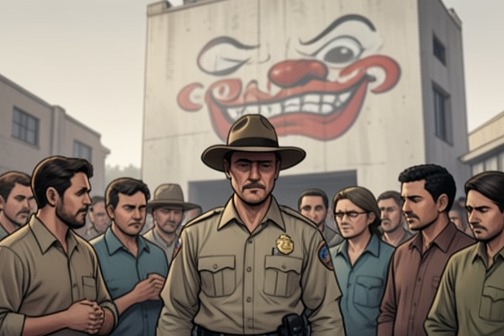
The [Founder’s Day prank](entity:event-recall-event-4b515e3c40f4) was an act of defiance amid a town festival that briefly looked like harmless entertainment. Its crowd-pleasing sparks and pops stood in sharp contrast to the effort by [Kettle Springs](entity:location-recall-location-kettle-springs-ab38acb2568d)’ leaders to control which young people belonged at the celebration. [Sheriff George Dunne](entity:character-recall-character-sheriff-george-dunn-e9f11dfd4f8e) later presented the stunt as the trigger for urgent action by the secret Kettle Springs Improvement Society, giving a moment of mischief a darker political afterlife.
## Background and Public Tension
At a town meeting before the festival, a resident asked Sheriff George Dunne about the [Baypen](entity:organization-recall-organization-baypen-63cac054ad9f) investigation and the dropped charges against [Cole Hill](entity:character-recall-character-cole-hill-7b3f7ee3f031). Dunne declined to discuss the case officially, then spoke off the record about a widening gap between what was legal and what he considered right. He said the town might soon face a moment when the law could not preserve Kettle Springs as its residents knew it, and invoked science teacher [Mr. Vern](entity:character-recall-character-mr-vern-7af919084c98)’s efforts to discourage certain students from attending the next day’s event.
Dunne framed that exclusionary appeal through the town’s accumulated losses. He pointed to [Arthur Hill](entity:character-recall-character-arthur-hill-d9433dafab37)’s child having died the previous year, the recent fire at Arthur’s factory, Kettle Springs’ declining population, and his claim that young people cared nothing for local history or heritage. He argued that the new generation needed to be brought into line and urged the assembled adults to act rather than wait for rescue. [Harlan Jaffers](entity:character-recall-character-harlan-jaffers-9f2f150ccaf2) tried to reclaim the meeting, but Dunne’s appeal held the audience. The prank took place in a climate where adult anxiety about the town’s future was already being directed at its young people.
## The Festival and the Prank
[Quinn Maybrook](entity:character-recall-character-quinn-maybrook-fdd4f8b5a108) had been reluctant to attend [Founder’s Day](entity:time-recall-time-founder-s-day-b7a557c3a5b5) and had no good explanation ready for her father for why she might skip it. After an hour at the festival, however, nobody had approached to ask her to leave or tell her she was banned. The event was larger than she had expected: food and music drew a crowd apparently augmented by visitors from neighboring towns, while a small carnival occupied the school parking lot, its rides and midway games brought in on trailers.
During the parade, sparks and sharp popping sounds began along the route. The volunteer firefighters looked at one another, bewildered, unsure how to respond. Many in the crowd took the commotion for part of the show and clapped and cheered. Quinn knew it was not on the official program, but smiled too. The narration presents the stunt as a possible act of defiance engineered by [Janet Murray](entity:character-recall-character-janet-murray-1da50990babd), while emphasizing its immediate effect: for the people watching, it was still fun, and it gave them joy. The prank’s public meaning therefore diverged from its unofficial intent; the crowd could enjoy the disruption without recognizing it as a challenge to the town’s management of the day.
## From Defiance to Pretext
The festival’s cheerful surface gave way to more dangerous scenes as the day progressed. At the later cornfield party, Quinn, Cole Hill, and Janet reached a clearing beside a disused barn and a leaning silo. Inside the crowded barn, heat built after several songs even with both doors open. When the attack began, partygoers struggled to escape: most moved toward the corn or tried to get into the barn as others worked to close its large wheeled doors. The confusion culminated in Erin Werther being struck by a bolt at the silo entrance and killed. These events mark a violent contrast with the festival crowd’s earlier belief that the parade’s sparks and pops were simply part of the entertainment.
Later, while driving Cole away from town, Dunne assigned the Founder’s Day stunt a strategic role in the violence. He said it had made people think they needed to act quickly, but also described the Kettle Springs Improvement Society as the product of months of recruitment and selective disclosure. The prank, in his account, did not create the Society; it supplied urgency to a conspiracy already being assembled. Dunne said [Dr. Weller](entity:character-recall-character-dr-weller-d638007293bb), once an outspoken supporter, had threatened to expose the group and that its members had dealt with the threat together.
## Retrospective Significance
Dunne’s explanation links the prank to a broader effort to portray young people as a danger to the town. He described them as a blighted crop that had to be cut out or burned to save the land, and treated their supposed moral defect as more important than whether phones, the internet, music, or social media had caused it. Cole answered that the adults’ nostalgia and refusal to listen to younger residents were part of the conflict. The contrast exposes how a harmless-seeming public disturbance could be recast as proof of a generational crisis.
The prank’s significance lies partly in that change of scale. For festivalgoers, an unscheduled burst of noise and light became a source of shared amusement; for Dunne, it became evidence that the town must act, and a reason to hurry a plan already under way. His later account reveals the political use made of the stunt without making his justification neutral: the Society’s campaign targeted an entire generation, while its leaders presented their own decision to use violence as a response to youthful disorder.
Event 11
Dr. Weller’s murder
[Dr. Weller’s murder](entity:event-recall-event-93d65442b71f) links the town’s hidden conspiracy to the corpse [Glenn Maybrook](entity:character-recall-character-glenn-maybrook-ac75628b4082) finds trapped with him: the former doctor had once supported the group, but became a threat when he tried to turn against it. The later revelation makes his death evidence of the Society’s willingness to silence even one of its own.
## Discovery of the Body
In a chamber where Glenn is confined, one final brush of debris exposes the corpse’s eyes. Glenn recognizes [Dr. Weller](entity:character-recall-character-dr-weller-d638007293bb), [Kettle Springs](entity:location-recall-location-kettle-springs-ab38acb2568d)’ former doctor, whose office photographs had made him seem far more alive; here, he has been buried in the chamber with Glenn and is unmistakably dead. The sight provokes Glenn’s nauseous retch before he finds his voice and screams for help, the effort flaring his head pain anew.
The discovery gives the murder a physical setting and an immediate consequence: Glenn is not alone in the chamber, but his companion is already beyond help. The contrast between the doctor’s photographs and his body makes the death stark without explaining how or when it occurred. The evidence does not specify the method of killing.
## The Threat Behind the Killing
Much later, while driving with [Cole Hill](entity:character-recall-character-cole-hill-7b3f7ee3f031) away from town, [Sheriff George Dunne](entity:character-recall-character-sheriff-george-dunn-e9f11dfd4f8e) explains how the Kettle Springs Improvement Society gathered people who might help carry out its plans. The group did not tell everyone everything at once, Dunne says, because full disclosure might have frightened members away. Dr. Weller had been one of its most vocal early supporters, but he threatened to expose the group. Dunne describes that as a problem the members fixed together.
Cole recognizes the implication and confronts Dunne with it: the group had not only murdered children. Dunne’s account connects Dr. Weller’s death to the Society’s internal discipline: support did not protect him once he threatened to betray its secrets. The confession establishes collective involvement, though it does not identify who killed Dr. Weller or describe the act itself.
## Revelation and Significance
The murder is disclosed in two stages: first as a corpse Glenn encounters without explanation, then as part of Dunne’s account of the Society’s history. That gap turns the discovery into more than an isolated horror. Dr. Weller’s body signals that the violence behind the town’s crisis reaches beyond its young victims and into the conspiracy’s own ranks.
His change from vocal supporter to would-be informant also exposes the Society’s limits as a coalition: its members could recruit people through gradual disclosure, but a threat to reveal the whole scheme was met with lethal violence. The murder thus shows the cost of dissent within the group and helps Cole understand that the conspiracy’s victims were not confined to the children it targeted.
Event 12
Glenn Maybrook’s kidnapping
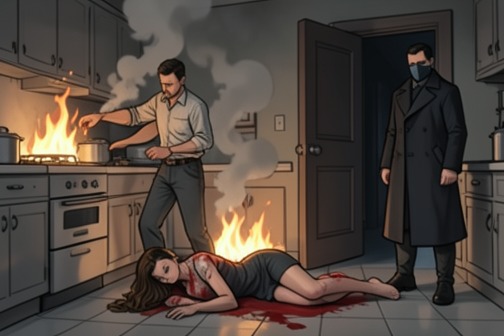
[Glenn Maybrook’s kidnapping](entity:event-recall-event-ac23d5da46d4) transforms a domestic routine into a staged captivity whose immediate purpose is coercion: the abductors demand to know where [Quinn Maybrook](entity:character-recall-character-quinn-maybrook-fdd4f8b5a108) is, then force Glenn to treat a wounded woman while threatening Quinn’s life. The episode moves from an unexplained crash to a blacked-out assault, a locked basement enclosure, and a grotesque medical ordeal, making Glenn’s professional knowledge both the reason he is useful and the instrument by which his captors control him.
## Causes and Attack
At 9:00, Glenn was cleaning dishes when an alarm reminded him to stop and move to the next task. He had set it to impose structure on his evening, and laughed uneasily at himself before reaching for his phone. A sudden crash against the outside of the house startled him so badly that the phone fell, bounced off the counter, and landed face down on the floor. The small domestic mishap marks the abrupt end of the evening’s ordinary rhythm; the impact is not explained before the danger escalates.
Outside, wind carried smoke and heat into Glenn’s face. He had initially treated the situation as a possible prank, but the flames and the threat to his safety became impossible to dismiss. Footsteps sounded on the grass behind him. The unseen attacker might have approached covertly, come around from the field, or simply appeared behind him; Glenn cannot establish which. He begins to turn with a golf club raised, but is struck sharply at the back of the head before he can defend himself. A tremendous pressure closes around his neck, his breathing fails, and the club slips from his grip onto the lawn.
The attacker asks where Glenn’s daughter is. He cannot answer: the blow has dazed him and the hold prevents him from speaking. His view of the amber flames gives way to darkness. The question makes the assault more than a random attack on a physician: from the outset, the abductors connect Glenn’s capture to Quinn, although their identity and full purpose remain concealed.
## Captivity and Setting
Glenn wakes to the stench of rot and severe pain at the back of his skull. His medical knowledge supplies possible explanations for the headache, but not certainty; he cannot tell whether his symptoms indicate one kind of brain bleed or another. That professional habit of diagnosis persists even as he becomes a helpless patient himself. His surroundings gradually resolve into a confinement space rather than a room: a cramped enclosure, roughly the size of a bathroom stall, inside a larger basement.
The enclosure’s construction makes the captivity visible and difficult to escape. Its back wall is solid wood paneling reinforced with chicken wire; the roof lies far above the short walls, with concrete and steel beams discernible in the darkness. A chain-link door at the other end appears to be padlocked. Beyond it, a bare bulb illuminates a folding chair and stairs leading upward. The floor outside the enclosure is dirt-streaked concrete, marked by footprints that look as though they were made by large boots. Inside, Glenn is hemmed in by a pile of corn mixed with feces. When he tries to push himself upright, the material sucks at his clothes like quicksand, and the futility of the effort stops him.
The scene’s confinement is reinforced by what Glenn finds nearby. [Dr. Weller](entity:character-recall-character-dr-weller-d638007293bb) is dead, and a mouse crawls out from between the corpse’s teeth after feeding on his tongue, its whiskers marked with pink froth. Glenn begins to scream, but a deep voice, digitally disguised and amplified by the darkness, orders him to stop and sit tight. The speaker says that Glenn is still alive and should count his blessings. The voice offers no identity or explanation, preserving the captors’ control over both the space and what Glenn is allowed to know.
## Coercion and Medical Ordeal
The disguised speaker warns Glenn to do as he is asked and suggests that compliance may keep him from joining those who will die that night. The warning establishes the immediate stakes without telling him what the captors’ larger plan is. Glenn is not simply locked away: his survival is presented as conditional, and the unseen speaker controls the terms on which he may remain alive.
That leverage becomes concrete when Glenn is made to treat [Trudy](entity:character-recall-character-trudy-42416d96a3a0). He protests that he has only tweezers, an old scalpel, and an inadequate first-aid kit, and points out that the tools are not sterile. The voice answers that Glenn had no medical supplies at home, so they had to make do, and tells him to do his best. The exchange exposes the practical logic of the captivity: the abductors need Glenn to use his medical ability, but have supplied only makeshift equipment and leave him to bear the risk of trying to save a patient under those conditions.
Glenn’s professional identity is therefore turned against his wish to leave emergency medicine behind. As he recognizes that he is losing the patient, the work he had wanted to escape becomes an imposed duty with an immediate human cost. Trudy tries to spit at him but cannot reach him; Glenn drops her hand and steps back, his head still throbbing. Her pain and agitation do not make the situation clearer or safer. Instead, they sharpen the contrast between the clinical task Glenn must attempt and the brutal circumstances in which his captors have placed him.
## Quinn as the Stakes
The kidnapping’s connection to Quinn becomes unmistakable only after Glenn has been forced into the medical ordeal. He recalls that the attackers asked for her when they took him and realizes that she, too, has become a target. The recognition retrospectively gives the earlier question at the scene of the assault a new weight: the captors did not merely want information in the moment; their interest in his daughter persists throughout his confinement.
The voice above Glenn warns him to consider his next action carefully, then says that his daughter is not dead yet. The threat makes Quinn’s survival a means of controlling her father and turns Glenn’s medical choices into part of a larger coercive arrangement. The available events leave the captors’ identities and ultimate objective undisclosed, but they establish the essential terms of the kidnapping: Glenn is imprisoned, Dr. Weller is dead, Trudy needs treatment, and Quinn’s life is being used to compel Glenn’s compliance. The movement from an alarm intended to organize the evening to a locked enclosure in which every decision carries a threat gives the episode its defining reversal.
Event 13
Tillerson Farm party massacre
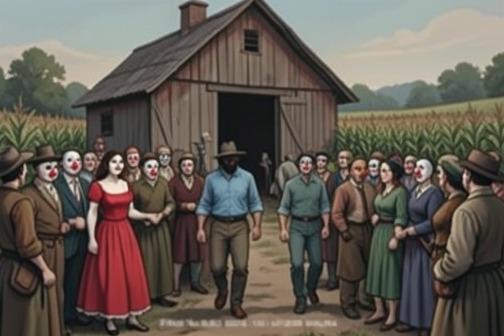
The [Tillerson Farm party massacre](entity:event-recall-event-c8d4e45d9450) is the novel’s decisive rupture between a town’s public festivities and its concealed violence: a crowded party in a barn and cornfield becomes a coordinated killing ground, and the attack is later exposed as part of a plan to preserve [Kettle Springs](entity:location-recall-location-kettle-springs-ab38acb2568d) by sacrificing its young people. Before the first assault, the story builds a world in which danger can be mistaken for entertainment, while the town’s adults and teenagers struggle over who gets to define disorder and belonging.
## Causes and Background
[Quinn Maybrook](entity:character-recall-character-quinn-maybrook-fdd4f8b5a108) arrives at [Founder’s Day](entity:time-recall-time-founder-s-day-b7a557c3a5b5) reluctant to attend and unsure how to explain to her father why she wants to avoid the festival. Yet for an hour nobody tells her to leave or reminds her that she is banned. The event proves larger than she expected: food, music, visitors from neighboring towns, and a small carnival assembled from rides and midway games in the school parking lot make the celebration feel expansive, even as shuttered businesses line [Main Street](entity:location-recall-location-main-street-e23229e4e5ad).
The festival’s public order is already unstable. [Janet Murray](entity:character-recall-character-janet-murray-1da50990babd) joins Quinn and presents herself in a thin cardboard half-mask shaped like [Frendo](entity:character-recall-character-frendo-92595b07eac5) the Clown; nearby, [Tucker Lee](entity:character-recall-character-tucker-lee-772373fbbac6) wears a more elaborate Frendo costume and rides a bicycle. The masks make the festivities playful, but they also blur the line between a costume and a credible threat. When sparks and pops begin along the parade, the crowd applauds, assuming the commotion is part of the show. Quinn knows it is not official, yet she smiles at the joy it gives people and tries not to let anxiety spoil the moment. The scene makes misrecognition part of the event’s groundwork: spectacle can absorb signs of danger until a sudden change in context makes them legible.
That public performance also carries an undercurrent of adult resentment toward the young. At [Kettle Springs High School](entity:location-recall-location-kettle-springs-high-27950c89da60), [Mr. Vern](entity:character-recall-character-mr-vern-7af919084c98)’s anger over students’ videos and antics turns a classroom outburst into a wider accusation: he describes the students as an impediment to learning and suspects Janet is filming him. His hostility suggests that the conflict is not simply about pranks or school discipline. The students’ cameras and online performances have become symbols in a generational dispute, one that the later violence will exploit rather than resolve.
The party at Tillerson Farm brings the crowd into a more isolated setting. Teenagers push through the corn toward a clearing roughly the size of a running track, where the barn’s open doors frame the dark rows on the far side. Beside it, the disused silo leans; its sparse red paint is cracking, and the barn roof sags. The buildings look neglected even before danger enters them. Inside, the packed dance floor grows oppressive after three songs despite both barn doors standing open, as body heat accumulates among the partygoers. The gathering’s apparent openness will soon prove deceptive: movement through the corn and the doors themselves will determine who can escape.
## The Assault and the Flight
The party’s change from crowded celebration to lethal attack begins when Quinn Maybrook and Janet Murray are still beside [Ginger Wagner](entity:character-recall-character-ginger-wagner-aa03bec367f0), who has fallen. Janet scrambles for her phone, which she drops into a puddle of beer; as she reaches for it, a clown emerges from the corn. His shoulders sit unevenly, and his chest heaves as if he has been running. The costume is no longer a festive disguise but the first clear sign that the party has been invaded by an armed assailant.
Frendo stops about ten feet away and raises a crossbow. Quinn is too stunned to move as he aims low and fires. The bolt passes between Quinn and Janet and strikes the dirt, missing [Ginger](entity:character-recall-character-ginger-7a5f4669310e)’s head by inches. For an instant, Quinn assumes the clown has missed. Then Ginger, who is in Quinn’s arms, slumps forward and gives a final shudder: the bolt has passed through her head, entered at the base of her skull, and exited through her left eye socket before burying itself in the ground. The speed of the shot and Quinn’s delayed recognition turn a near miss into the scene’s horrifying confirmation that the clown is killing deliberately.
From the edge of the barn, [Cole Hill](entity:character-recall-character-cole-hill-7b3f7ee3f031) sees the same attacker take aim at Janet. This shot goes wide of her but hits someone in the confusion; Cole cannot tell whether the victim is Pat Horner. At the barn entrance, shouts to run and warnings of an active shooter send the party into panic. The familiar language of school emergency drills becomes the crowd’s frame for understanding what is happening, but it offers no protection from the actual violence.
As Cole, Janet, and Quinn head for the barn doors, Frendo finishes reloading and fires again. Jake Peps falls face-first into a raised firepit; the flames flare around him, and he screams and writhes in the embers. Cole instinctively starts toward him, remembering a friendship that reaches back to kindergarten and the French toast sticks Jake’s mother made for them after Cole’s first sleepover. [Ronnie Queen](entity:character-recall-character-ronnie-queen-4bf4ae3c9c72) yanks Cole back, insisting that Jake is gone, while [Matt Trent](entity:character-recall-character-matt-trent-1c7c67cb0479) grips his arm and helps pull him away. The flight forces Cole to abandon the impulse to help a familiar classmate, replacing the ordinary obligations of a small school with the immediate work of survival.
The crowd breaks in different directions: some partygoers run toward the corn, while others try to get into the barn as a group works to close its large wheeled doors. Cole is instead swept toward the disused silo with Ronnie and Matt. Erin Werther holds its small door open as they approach; a crossbow bolt slips through the gap between door and jamb and strikes her in the side of the head, shattering her glasses and killing her before she reaches the floor. Matt sees Erin’s body land at his feet and turns away, coughing as if he is about to vomit. The door remains open by about a foot as the survivors stand horrified, the narrow entrance offering no reliable boundary between shelter and attack.
## The Attack Expands and the Escape Narrows
The survivors’ flight does not end at the barn. [Ruston Vance](entity:character-recall-character-ruston-vance-76a93a1e0202) points out a chain joining the handles of the closed back doors, secured by a padlock on the outside. The discovery explains why their classmates cannot get out: the doors are not merely blocked by the panic and crush of the crowd but deliberately fastened against them. Quinn Maybrook raises her shotgun and focuses on the instruction Ruston Vance had given her about bracing the stock, while they run toward the doors to help those trapped inside.
Ruston Vance tries to break the lock with his shotgun. He rests the weapon almost horizontally, with its butt in the dirt and the padlock wedged against the barrel, and warns the people inside to move back before firing. The blast tears away part of the barn doors in a shower of splinters, but it strikes high, away from the area where he hopes people are standing. When he reaches for the chain, he burns his hand on the lock. The attempt makes the obstruction—and the danger to the people on both sides of it—plain: even a rescue effort risks injuring those it is meant to free.
The threat also proves larger than a single masked attacker. Frendo pursues Janet Murray out of the cornfield, no longer carrying the crossbow but a smoking circular saw with a blade at least a foot and a half wide. He closes the distance as she turns to face him. Ruston Vance and Quinn Maybrook then see two more clowns emerge from the corn near the road, one carrying a hooked blade and the other a chainsaw. From the far side of the barn, another armed clown appears with a crossbow. The number and spread of the attackers overturn any possibility that the violence is one assailant’s isolated rampage: the party is being surrounded by a coordinated force.
When [Sheriff George Dunne](entity:character-recall-character-sheriff-george-dunn-e9f11dfd4f8e) arrives, the survivors’ weapons and the costumes worn by Ronnie Queen and Matt Trent feed his suspicion rather than persuading him that they are victims. He notices Quinn Maybrook holding a shotgun and treats the two boys’ Frendo outfits, their drinking, and the apparent fake blood as reasons to question their account. He describes a night of confused reports, including a call about a fire in [Tillerson B-field](entity:location-recall-location-tillerson-b-field-f646e607a956) and another caller’s mistaken impression that an explosion had created a mushroom cloud. His response leaves the survivors struggling to make themselves credible at the very moment the scale of the attack demands that they be believed.
## The Conspiracy Revealed
The massacre’s apparent chaos is finally explained as a political operation. As Sheriff George Dunne drives Cole Hill away from the farm, Cole realizes they are not heading back to town. Dunne traces the conspiracy to the Founder’s Day stunt: it made residents believe that action had to be taken quickly. For months, he says, he and his allies had been gathering people into the Kettle Springs Improvement Society, disclosing their intentions gradually and selectively. [Dr. Weller](entity:character-recall-character-dr-weller-d638007293bb), once among their vocal supporters, threatened to expose them; Dunne describes that threat as a problem the group resolved together. The account makes the assault more than a sudden outbreak of violence: it was the culmination of a campaign to move the town toward accepting the killing of its young people.
Dunne also explains how the conspirators manufactured consent. Rather than openly proposing a purge, they listened to residents, affirmed what they wanted to hear, and steadily shifted the limits of what the town would consider acceptable. The party was not necessarily the original purpose of that campaign; it was a convenient opportunity. The conspirators knew where and when the gathering would take place and that Cole’s social circle would be there, making the farm a setting where they could target the teenagers they had identified while presenting the violence as a solution for Kettle Springs.
The planned cover-up turns the survivors’ vulnerability into part of the attack. Dunne intends to make the deaths look like a suicide and blame Cole, Quinn Maybrook, and Ruston Vance. He says the conspirators used crossbows and chainsaws to reduce ballistic evidence, then boasts that the scene may provide more evidence against the three teenagers rather than less. His scheme depends on the public finding a story of an armed, heartbroken teenager more plausible than a coordinated conspiracy by adults. The uniforms and weapons that made the survivors seem suspicious to Dunne at the farm are thus not incidental details: he is preparing to use them as props in a false account.
This revelation recasts the event’s earlier confusions without making them less consequential. At Founder’s Day, a crowd mistook unauthorized sparks and pops for part of the entertainment; at the farm, the attackers’ Frendo masks and the students’ own costumes helped blur who was performing, who was in danger, and whom authorities should believe. Dunne’s plan exploits that confusion deliberately. The massacre is therefore both a physical assault and an attempt to control its public meaning: the conspirators seek not only to kill the teenagers, but to make their deaths appear to confirm the very threat the town has been taught to fear.
Event 14
The grain silo explosion
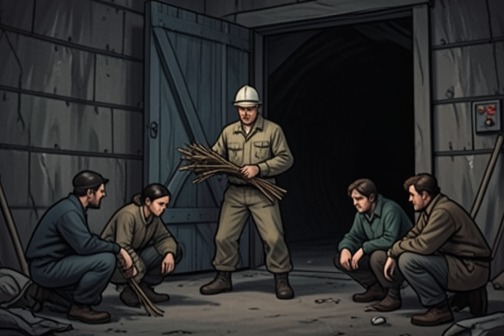
[The grain silo explosion](entity:event-recall-event-b365023787b8) turns a desperate search for escape into an apparent act of self-sacrifice. When [Ruston Vance](entity:character-recall-character-ruston-vance-76a93a1e0202) discovers old dynamite in a crate on the silo floor, he recognizes it as the survivors’ chance to get out. He rigs two sticks while [Cole Hill](entity:character-recall-character-cole-hill-7b3f7ee3f031) leads the others toward a loading pit beneath the grating; as the explosion comes, Ruston remains behind, and the survivors believe he has died. The blast breaks the immediate confinement but does not bring safety: another [Frendo](entity:character-recall-character-frendo-92595b07eac5) steps out of the smoke, still armed and advancing.
## Discovery and Stakes
The explosives appear almost by accident during a tense pause in the siege. Ruston asks whether there are children smoking in the silo, then lifts a small crate with two rope handles. Its size—slightly larger than a shoebox—makes its contents all the more startling. He carries it from the grating to the silo’s dirt floor and opens it to reveal weathered, weeping sticks of dynamite. Ruston jokes that the box may be the only fishing gear Paul Tillerson uses, but the discovery immediately changes the survivors’ prospects: what looked like stored equipment becomes a possible way out.
The dynamite is old, and its condition makes the plan dangerous even before the attackers reach the door. Ruston lifts a stick carefully with his fingertips. Its slick coating looks to Cole like sea salt and olive oil, but Cole recognizes that it is probably nitroglycerin. The detail makes the rescue plan inseparable from its risk: the means of escape is unstable explosive, not a reliable tool. [Quinn Maybrook](entity:character-recall-character-quinn-maybrook-fdd4f8b5a108), who has backed away from the hole in the door to join the group, pleads with Ruston not to kill them all. He promises that he will not, then gives Cole a specific task: find the hatch to the loading pit and get everyone below.
## A Plan Under Attack
There is little time to prepare. An axe slams into the door again, striking a different spot from where Quinn had been aiming and cracking the old wood. Outside, the attackers’ pressure escalates when the sound of a chainsaw begins. The group has to divide its attention between the threat breaking through the entrance and Ruston’s attempt to make the dynamite usable. This is not a controlled demolition: the fuse is short, the sticks are ancient, and the door is under direct attack.
Ruston twines the short fuses of two sticks together, holding a lighter between his teeth as he works. He shouts for Cole to move, and Cole drops to the floor and pulls at the grating until he finds a three-by-three section that lifts by a rusty O-ring. The opening leads into a loading pit with only about two and a half feet of clearance between the grating and the floor. [Ronnie Queen](entity:character-recall-character-ronnie-queen-4bf4ae3c9c72) goes down first, stepping carefully into the confined space; Cole directs the others to follow. The cramped shelter is the only immediate protection the group has from the blast.
## Ruston Stays Behind
As the others descend, someone asks what will happen to Ruston. The question makes the cost of his plan explicit: the dynamite does not seem to have much fuse, and he is still crouched beside it, working frantically. Ruston tells Cole he will be fine and insists that Cole must go now. Their locked eyes convey what his reassurance cannot. Cole understands that Ruston is lying, and understanding is painful because it means accepting that his friend intends to stay behind.
[Matt Trent](entity:character-recall-character-matt-trent-1c7c67cb0479) reinforces the order to get into the pit, invoking the punch he owes Cole. The exchange briefly recalls their earlier conflict and turns it into a push toward survival, but it cannot change the danger Ruston has chosen to face alone. Cole enters the pit with the others. The improvised arrangement leaves Ruston above them with the dynamite and the attackers closing in, while the rest of the group can only wait below the grating.
## The Blast and Its Aftermath
The silo explodes as Quinn demands her rifle back from Ronnie. For a few seconds, the blast’s heat and rushing force seem to press everything flat, and the night turns to day. Quinn experiences the interruption as something like a long blink rather than a clear loss of consciousness. The sudden flare and the survivors’ disorientation make the explosion a violent break in the scene, but not a resolution: when Quinn can sit up, Cole is already watching the place where the silo stood and sniffling.
Ronnie’s hair is smoking, though Quinn sees no flames threatening to catch it. Quinn crawls over and takes her rifle back. The survivors look at the hole in the ground where the silo had been, with no apparent sign that Ruston could have escaped. Cole concludes that Ruston blew up the attackers and sacrificed himself to stop them. The moment gives the blast its emotional consequence: the escape has come at the perceived cost of the person who made it possible.
That conclusion is immediately unsettled. Matt points toward the clearing, where another Frendo steps through the smoke and fire. The clown wipes a long, curved machete against a pant leg, then points the blade at the survivors. The dynamite has destroyed the silo and apparently taken Ruston with it, but it has not eliminated the attackers. The sequence therefore ends not in rescue but in a reversal: the survivors have escaped the structure, lost sight of their ally, and must face a still-armed enemy in the open.
Event 15
The attempted execution and rescue inside the Baypen factory
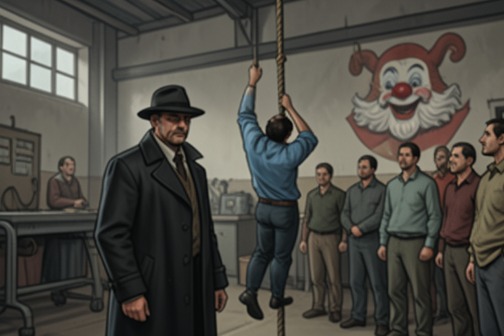
[The attempted execution and rescue inside the Baypen factory](entity:event-recall-event-baypen-6baffafeecc1) is the confrontation in which Sheriff Dunne’s plan to restore [Kettle Springs](entity:location-recall-location-kettle-springs-ab38acb2568d) becomes a threat to [Cole Hill](entity:character-recall-character-cole-hill-7b3f7ee3f031)’s life, and [Quinn Maybrook](entity:character-recall-character-quinn-maybrook-fdd4f8b5a108) intervenes to stop it. The scene brings together the town’s restorationist ambition, Cole’s rupture with his father, and Quinn’s decision to risk herself for him.
## Setup and Intended Execution
Sheriff Dunne brings Cole into the fire-damaged [Baypen](entity:organization-recall-organization-baypen-63cac054ad9f) factory and explains his vision: Baypen will reopen, Kettle Springs will be saved, and [Frendo](entity:character-recall-character-frendo-92595b07eac5) will prevail. He presses a garage-door opener strapped to the dashboard radio, raising the loading-dock shutter beneath a mural of Frendo whose painted mouth seems to open over the factory floor. In the darkness inside, the cost of Dunne’s promise becomes clearer. Cole sees a noose hanging from a burned-out catwalk leading to the foreman’s office and realizes whom they are waiting for. The factory’s damaged machinery and surviving industrial structures turn the site of Baypen’s supposed renewal into the setting for an execution.
## The Father-Son Confrontation
[Arthur Hill](entity:character-recall-character-arthur-hill-d9433dafab37) emerges from the foreman’s office, suspended above the factory floor, and Cole recognizes that the noose is meant for him. He pleads with his father not to go through with the plan, but Arthur answers that Cole has not been his son for years and that their estrangement began before the reservoir. The accusation recasts the confrontation as more than a staged punishment: Arthur has folded years of resentment into the violence unfolding at Baypen.
Cole insists that he was grieving his mother, making explicit the loss at the center of the break between them. Arthur does not acknowledge the plea. Sheriff Dunne keeps Cole under control by twisting the chain between his cuffs, turning the family exchange into a spectacle conducted under the sheriff’s authority. Cole’s appeal cannot reach his father, and the execution proceeds toward its next turn.
## Quinn’s Intervention and the Interrupted Rescue
Quinn Maybrook reaches the factory floor by slipping through a broken window and picking her way along the suspended gangways and scaffolds, where amber safety lights mark a route between mixing drums and pressurized vats. She appears behind Arthur Hill with a rifle aimed at his spine and forces him toward the circle of light, demanding that [Sheriff George Dunne](entity:character-recall-character-sheriff-george-dunn-e9f11dfd4f8e) remove the noose from Cole Hill or she will kill Arthur. Her intervention reverses the scene’s arrangement: the man who had seemed to control the execution is now confronted with a hostage and an armed opponent.
Dunne answers with gunfire. His shot strikes Arthur in the shoulder, knocking Quinn’s rifle barrel aside; Cole calls out to his father, then twists in Dunne’s grip and attacks the sheriff. Dunne rushes toward the walkway’s edge and throws Cole over the railing by the noose. Quinn fires back, hitting Dunne in the stomach, while Arthur falls and begins to regain consciousness. Cole remains suspended above the factory floor, his hands cuffed behind him; after struggling briefly, he goes limp. Quinn has wounded the sheriff but has not yet freed Cole, and the rescue reaches its most precarious point just as the execution appears to have succeeded.
The gunfire brings [Glenn Maybrook](entity:character-recall-character-glenn-maybrook-ac75628b4082) toward the voices. He is trembling, despite two decades of work in emergency-room settings, and steadies his hand around a scalpel before moving through the industrial wreckage. He believes he can help Quinn, but another gunshot makes him fear he is too late. Wearing a mask that interferes with his peripheral vision and balance, he emerges from behind the mixing drums and runs toward the confrontation. His arrival opens a further possibility of rescue, but this moment ends with Cole still hanging and the outcome unresolved.
## The Mask and the Meaning of “Frendo Wins”
The scene’s apparent costumed witness is revealed as [Janet Murray](entity:character-recall-character-janet-murray-1da50990babd)’s stepfather: he lifts the [Frendo mask](entity:object-recall-object-frendo-d29d4425be10), and Cole recognizes the bald, unremarkable man beneath it. His presence ties the town’s clown iconography to a participant in the conspiracy, while Cole’s startled thoughts turn immediately to Janet and her mother, whose knowledge and whereabouts he cannot establish. The mask is not the face of an unknown attacker here; it conceals someone connected to the people Cole knows.
That reveal sharpens the meaning of Sheriff George Dunne’s repeated claim that “[Frendo wins](entity:expression-recall-expression-frendo-wins-006b17ff8e35).” His plan joins the clown’s victory to Baypen’s reopening and Kettle Springs’ supposed salvation, making the factory’s industrial revival inseparable from the threatened execution. The language of renewal therefore sits beside the noose and the masked enforcers, exposing the violence beneath Dunne’s promise. Yet the rescue remains unsettled: Glenn Maybrook hears Quinn’s voice, moves toward the factory-floor confrontation, and hears another shot before he can reach her. His arrival supplies a possible intervention, not a confirmed escape or a resolution to Cole’s danger.
Event 16
Kettle Springs clown attacks
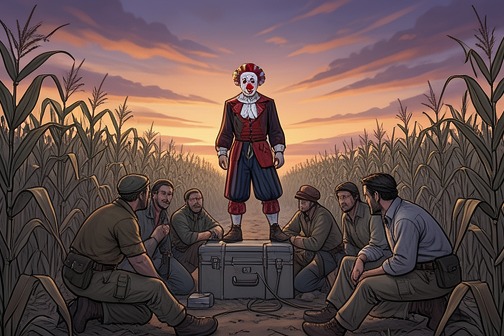
The [Kettle Springs clown attacks](entity:event-recall-event-kettle-springs-clown-at-bcd04c392a7d) were the violent culmination of a conspiracy that sought to preserve the town by targeting its young people. The attacks left [Kettle Springs](entity:location-recall-location-kettle-springs-ab38acb2568d) with a decimated population and survivors carrying lasting trauma, but the conspirators did not achieve the future they intended: the young people persisted, the plot was exposed, and the town began to recover in public view.
## Conspiracy and Unintended Outcome
The attacks were connected to a plan devised by [Arthur Hill](entity:character-recall-character-arthur-hill-d9433dafab37) and [George Dunne](entity:character-recall-character-george-dunne-b3c17481c69c). In the aftermath, [Quinn Maybrook](entity:character-recall-character-quinn-maybrook-fdd4f8b5a108) understood the contradiction at its center: the plan had worked in the sense that its authors and their twelve known conspirators believed they had saved Kettle Springs, but events had overturned their meaning of success. The town’s population had been decimated, yet the young people the conspirators had tried to eliminate remained. Even if [Cole Hill](entity:character-recall-character-cole-hill-7b3f7ee3f031), Quinn, and [Ruston Vance](entity:character-recall-character-ruston-vance-76a93a1e0202) had died in the refinery, Quinn believed, the clowns would not have won. The intended purge had failed to extinguish the generation it targeted.
That conclusion was not an abstract comfort for Quinn. In the immediate aftermath, she persuaded [Glenn Maybrook](entity:character-recall-character-glenn-maybrook-ac75628b4082) that they should stay in Kettle Springs rather than leave the violence behind. She regarded the town as their home and felt that retreat would let the attackers win. Her decision turned survival into a claim on the place itself: remaining meant refusing to surrender the future to the people who had spilled blood in its name.
## Investigation and Exposure
The conspiracy did not remain hidden after the attacks. Shortly after the [Federal Bureau of Investigation](entity:organization-recall-organization-c3b9c0848e8c) arrived, investigators questioned and arrested people connected to it. The evidence included Arthur Hill’s phone records, emails from the sheriff’s office, and GPS data from phones that had registered at Kettle Springs Improvement Society meetings. Those records made it difficult for accomplices to conceal their involvement, although many were already dead.
The method of exposure carried a sharp irony. The clowns had been poor at covering their digital traces, and Quinn recognized that the phones they despised had helped bring them down. She was certain that the conspirators would have been caught even if they had survived and succeeded in killing her and her friends. Their failure to master technology meant that the plot’s reach could be reconstructed through the very devices their anti-technology outlook rejected.
## Survivors and the Return to School
[Kettle Springs High School](entity:location-recall-location-kettle-springs-high-27950c89da60) resumed classes at the beginning of December. Around twenty students returning to school had been at the party in [Tillerson B-field](entity:location-recall-location-tillerson-b-field-f646e607a956) on the night of the attacks. Most had survived being locked in the barn and escaped into the corn before the clown reinforcements arrived. Their return marked a concrete continuation of the student body the attackers had tried to destroy.
Another fifteen or so students had simply not gone to the party. Quinn treated their absence as a small, grimly comic argument for staying home on weekends: sweatpants and bad television had, in this instance, kept them away from danger. The contrast between those who had been trapped and those who had stayed away does not diminish the attacks; it shows how survival in Kettle Springs depended partly on circumstances as ordinary as whether a student went out that night.
Survival did not mean an immediate return to normal. Quinn’s hands sometimes shook, and she kept the lights on throughout the house. Her dreams had already been terrible since her mother’s death, but she had now lived through another terrible event, one that could not leave her unchanged. The attacks persisted in the survivors’ habits and fears even as school reopened and the town’s daily life resumed.
## Recovery, Attention, and the Town’s Future
In the days and weeks after the attacks, Kettle Springs drew an influx of outsiders: television news crews, state and federal law enforcement, and several true-crime documentary teams. Their presence brought practical consequences for a town whose population had been decimated. Visitors needed places to stay and eat, producing an economic boost that lasted for months. Some local residents bristled at the attention, while most appreciated the newcomers and the business they brought.
Quinn declined several offers to discuss her experiences on camera, but other survivors chose to speak. One production team arranged an exclusive joint interview with Cole Hill and Ruston Vance, and had already presold a planned three-part miniseries to Netflix. The town’s catastrophe thus became both a subject of public fascination and a source of renewed activity; Quinn’s refusal to perform her experience for the cameras existed alongside other survivors’ willingness to tell theirs.
The town also began removing the clowns’ visible presence. Businesses quickly took down [Frendo](entity:character-recall-character-frendo-92595b07eac5)-themed window displays, while demand for white paint and power washers reached an all-time high as residents scrubbed clown imagery from murals and signage. These acts of cleanup were modest beside the violence, but they made recovery visible in the places people passed every day. The attacks had left Kettle Springs altered; they had not made the town’s public identity permanently belong to the clowns. Its young people returned, its residents stayed, and the perpetrators’ effort to decide the town’s future ended in exposure rather than victory.
Event 17
Arthur Hill flees to Cuba
[Arthur Hill](entity:character-recall-character-arthur-hill-d9433dafab37)’s flight to [Cuba](entity:location-recall-location-cuba-419261c764da) reveals that his apparent death was not an ending but a concealment: after the massacre and the collapse of his plan for [Kettle Springs](entity:location-recall-location-kettle-springs-ab38acb2568d), he survives, escapes detection, and prepares to pursue revenge personally. The epilogue makes his disappearance a reversal of the town’s presumed resolution, leaving Arthur at large and the violence unfinished.
## The Disappearance and Its Aftermath
Arthur’s escape begins with evidence that points in two directions at once. The amount of blood at the scene and the extensive manhunt led authorities to declare him legally dead, yet no body was found. Drones searched the cornfields, dogs were brought in, and investigators discovered a blood trail from the place where Arthur had been shot to an exit at the [Baypen](entity:organization-recall-organization-baypen-63cac054ad9f) factory. There the trail ended. With acres of fields around the factory and a six-hour head start before search crews could be redirected from Tillerson’s B-field, Arthur could have fled in many directions—or died somewhere beyond the searchers’ reach. To [Quinn Maybrook](entity:character-recall-character-quinn-maybrook-fdd4f8b5a108), the corn seemed to have swallowed him.
The uncertainty persists in the aftermath. Quinn does not ask [Cole Hill](entity:character-recall-character-cole-hill-7b3f7ee3f031) about Arthur, despite the money Cole now has access to and the possibility of developments concerning the insurance. The subject is too painful and sensitive. Arthur’s legal death therefore coexists with an unresolved physical absence: the search has produced a trail, but neither a body nor proof of where he went. The epilogue answers the central question of his survival without making his escape secure or complete.
The flight also follows the exposure of the scheme Arthur and [Sheriff George Dunne](entity:character-recall-character-sheriff-george-dunn-e9f11dfd4f8e) built around the idea of saving Kettle Springs. Dunne described young people as a blighted crop and argued for cutting them out to preserve the land. He acknowledged that the town had been guided toward this logic gradually: its leaders listened to residents while shifting the boundaries of what they considered acceptable. The Tillerson Farm party, where the young people would gather, was chosen as a convenient opportunity to carry out the violence. In the immediate aftermath, Quinn persuaded her father that they should remain in Kettle Springs rather than retreat, because leaving would mean allowing the attackers to win. Arthur and Dunne’s plan had, in one sense, achieved its stated aim of saving the town, but not in the way they intended or expected. Arthur’s flight begins from the wreckage of that failed design.
## The Flight and the New Rule
The epilogue shifts from the searchers’ uncertainty to Arthur Hill’s presence aboard a flight bound for Cuba. He has kept his sunglasses on throughout the journey, and his black garment bag hangs from a headrest across from him, arranged almost like another passenger. The ordinary details of air travel sharpen the contrast with his hidden identity: Arthur is not merely missing in the corn, but alive, in transit, and carrying the means to change his appearance.
The escape has altered his understanding of failure. Arthur concludes that money is not everything, but ready cash can keep a person alive and out of jail; he also decides that failure need not be permanent if someone remains determined to finish a plan. The most consequential lesson is that a job must be done personally. He sees delegation as the mistake that undermined his revenge, treating it like a business operation rather than taking responsibility for it himself. As the plane descends, he repeats this principle to himself, turning it into a private rule for what comes next.
Arthur’s concealment becomes urgent when he notices that the pilot appears to recognize him, whether from an earlier flight or from the news. He unbuckles before landing despite the pilot’s announcement, slips into the cramped bathroom, and brings the garment bag with him. There he pulls on a jumpsuit and lowers a mask over his face. The disguise makes concrete his renewed faith in symbols: recalling Sheriff George Dunne’s belief in their power to gather people around a cause, Arthur regards this figure as his own legacy and birthright.
The plane is a very light jet, so Arthur expects no ground crew to impede his exit; he considers how to get off the runway or out of the hangar after landing. A heavy knife is already in his hand. He has been responsible for dozens of deaths, he recognizes, but not the death he truly wants. The ending does not identify that intended victim or show the attack; instead, it closes on Arthur preparing to act for himself, his repeated rule turning the apparent escape into the beginning of a further threat.
## A Coda That Refuses Closure
The epilogue turns a question of evidence into a question of intention. For Quinn Maybrook and the searchers, the trail’s end leaves open whether Arthur Hill escaped or died unseen; the shift to Arthur’s own perspective resolves his survival while withholding the identity of the person he means to kill. His admission that dozens of deaths have not accomplished the one he wants makes the escape more than a flight from arrest: it is the continuation of a revenge whose central target remains undisclosed.
That withheld target keeps the town’s apparent recovery from becoming a clean ending. Quinn Maybrook has chosen not to let the attackers drive her and her father away, while Arthur’s closing resolve points toward violence beyond the massacre’s immediate aftermath. The repeated insistence that a job must be done personally serves as both the conclusion to his account of failure and the epilogue’s final warning: the plot closes on his determination, not on the completion of his revenge.
## The Civic Grievance Behind the Escape
Sheriff George Dunne presented Arthur’s withdrawal from Kettle Springs as both a private bereavement and a public crisis. He called Arthur one of his oldest friends, though they rarely spoke by phone, and told the town that Arthur had lost his daughter the previous year and his factory only the week before. The refinery’s possible reopening had become a focus for residents hoping for investment, but Dunne argued that Arthur would not put money into a town whose population was falling and whose young people, in his view, showed no regard for its history. The assembled civic groups nodded along. Dunne’s account turned grief and economic decline into a case for action, making the town’s losses part of the justification for the violence that followed.
His language also shows how the conspiracy converted resentment into a rationale for collective punishment. Dunne declared the younger generation bad without settling whether technology had made them so or they had been born that way; to him, the cause mattered less than the result. He likened them to a diseased crop that had to be cut, culled, or burned to save the land. In the epilogue, the FBI knows of twelve conspirators in addition to Arthur and Dunne. Their effort to preserve Kettle Springs thus rested on defining an entire generation as a threat, while the town’s survival after the attack depended on Quinn Maybrook’s refusal to leave. Arthur’s escape to Cuba carries this contradiction beyond the immediate aftermath: the man who helped turn communal fear into a campaign of violence remains alive, and his own grievance has not run its course.